
Charter tips are the number one reason crew choose charter yachts over private yachts — and the number one thing that people misunderstand before they get on board. The headline figures are real: $500–$2,000 per crew member per charter week, on top of your base salary. In a busy Med summer, that changes your total income significantly. But how tips work, how they’re divided, and what affects the amount is something most people don’t understand until their first charter. This guide explains it clearly. If you’re still figuring out how to get on board in the first place, start with our yacht crew job guide and the STCW guide. For salary figures across every role and yacht size, read our full yacht crew salary guide. For training that gets you onto a charter yacht, see our deckhand and stewardess training packages.
What Actually Determines Your Pay
Why the Size of the Yacht Changes Everything
Tip income on a charter yacht is directly tied to the charter fee, and charter fees are directly tied to yacht size. A 30m yacht charters for €20,000–€50,000 per week. A 50m yacht charters for €80,000–€200,000 per week. A 70m+ superyacht can charter for €300,000–€600,000+ per week. Guests who tip at 10–15% of the charter fee are tipping very different amounts depending on what they’ve paid.
The number of crew the tip is split between also matters. A 30m yacht might have four to six crew. A 70m yacht might have 18–25 crew. So while the tip pool on a larger yacht is much bigger in absolute terms, the per-person amount doesn’t always scale linearly. Most experienced crew find that 40–55m yachts hit the sweet spot: high enough charter fees for meaningful tips, small enough crew numbers for each person to receive a significant share.
Med vs Caribbean: How Location Affects Your Tips
The Mediterranean and the Caribbean are the two main charter seasons. The Med (April–October) and the Caribbean (November–April) both generate substantial charter income, but the distribution of high-value charters differs. The Med in high summer — July and August — generates the most concentrated charter income of anywhere in the world. Cannes, St Tropez, Monaco, Portofino: the charter rates in these locations during peak summer are at the top of the global market.
The Caribbean season is longer and more spread out. December–March is peak, with guests from the US and Europe taking winter sun. Charter rates are generally slightly lower than peak Med, but the season length compensates. Crew who work both seasons — following their yacht from Med to Caribbean — earn the most consistent tip income year-round.
What Each Role Actually Earns
Base salaries plus charter tips give you total compensation. Here’s the full picture across common roles:
- Junior deckhand / junior stew: $2,500–$3,500/month base + $500–$1,000/charter week tips
- Deckhand / stewardess (1–2 years): $3,000–$4,500/month base + $800–$1,500/charter week tips
- Bosun / second stew: $4,000–$6,000/month base + $1,000–$2,000/charter week tips
- Chief stew / chief officer (40–50m): $5,000–$7,500/month base + $1,500–$2,500/charter week tips
- Captain (40–50m): $8,000–$12,000/month base + $2,000–$4,000/charter week tips
These are illustrative — actual tip splits are at the captain’s discretion, and different boats handle it differently. See the full role-by-role breakdown in our yacht crew salary guide.
What Our Graduates Actually Earn on Charter
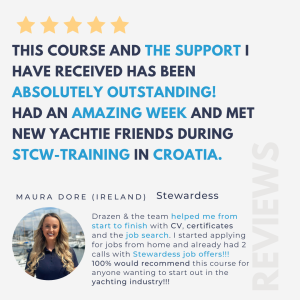
Maura joined our Premium Stewardess programme in Split with no superyacht experience. She received two stewardess job offers during the training week and stepped directly onto a 70m superyacht — a primary charter vessel working the Med summer season. At 70m, charter fees run €300,000–€500,000+ per week. At 10–15% tip, that’s a tip pool of €30,000–€75,000 split between 20–25 crew. As a junior stew in her first season, her base salary plus charter tips put her well ahead of anything available to her on land.

Shana completed her training and landed her first job on a 60m M/Y one week later. Jordan Prendergast got a job before the training week was even over. The difference between graduates who get onto charter yachts quickly and those who don’t isn’t luck — it’s the quality of the CV, the dock walking preparation, and starting in the right location. Split is a Med charter hub. You finish training and you’re already where the boats are.
“In my home country I would have paid the same price for just basic safety and not got all the extra support and guides. I got my first job very quickly with their instructions and they still give me full support.”
— S. Sudaporn, Thailand ★★★★★
Captain Pay
Captains on charter yachts earn significantly more than captains on private yachts of equivalent size because their total compensation includes both a higher base (to reflect the commercial programme) and a portion of charter tips. On a 50m charter yacht doing 15–20 charters per season, a captain’s total annual income can exceed $200,000 when tips are factored in.
Charter Tips: The Real Money
How Much Guests Actually Tip
The standard in the superyacht charter industry is 10–15% of the charter fee. Some guests tip at this level automatically; others tip more if the crew has delivered an exceptional week; others tip less if there were issues. The 10–15% figure is the expectation the industry runs on and the figure crew can reasonably plan around.
What this means in practice on a 50m yacht chartering at €150,000 per week: a 10% tip is €15,000, split between ten crew. That’s €1,500 each — approximately $1,600 — for one week’s work, on top of your base salary. In August with three back-to-back charters, that’s nearly $5,000 in tips alone that month.
What Makes Guests Tip More
Guests who’ve had an exceptional charter experience tip above the standard rate. The factors that drive above-average tips:
- The crew anticipated their preferences without being asked — the drink they ordered on day one appeared ready at the same time on day two
- Problems were handled invisibly — a mechanical issue, a provisioning error, a bad weather day that required a change of plan — all resolved without the guests being aware of the difficulty
- The service standard remained consistent throughout — not great on day one and slipping by day six
- The crew were professional but personable — guests felt like they were looked after by people who genuinely cared rather than performed a service
- Any special events — a birthday dinner, a proposal, an anniversary — were executed perfectly
Crew who contribute to any of these outcomes — from the deckhand driving the tender smoothly to the chef adapting the menu for a guest’s new allergy — contribute to the tip total. The captain’s job is to make sure that’s clear to the crew before tip week begins.
Getting onto a charter yacht starts with the right approach to job searching. Read our dock walking guide for the practical steps that get you in front of captains in person.
Does the Season Change Your Tips?
Yes, significantly. Peak Med (July–August) and peak Caribbean (December–January) generate the highest charter rates and therefore the largest tip pools. Shoulder season charters — May and June in the Med, March and April in the Caribbean — still pay well but at slightly lower rates. The difference between a peak-season charter and a shoulder-season one can be 20–40% in terms of the charter fee, which flows directly through to tip amounts.
Charter Yacht vs Private Yacht: The Pay Difference
Why Base Salary Differs Between Yachts
Private yachts — used only by the owner’s family and invited guests, with no commercial charter programme — pay slightly lower base salaries than charter yachts of equivalent size. This is because the work is generally less intensive (no back-to-back charters, no 12-guest turnovers every Saturday morning) and there are no charter tips. Private yacht crew trade intensity and tip income for a potentially more relaxed programme and longer stability with one employer.
Charter yachts pay more in total but demand more in return. During peak charter season, 12–16 hour days are standard, seven days a week. Between charters, the turnover window (cleaning the yacht and resetting for the next guests) is typically 24–48 hours. It’s demanding work and the tip income reflects that.
What Else You Get Beyond Your Salary
In addition to base salary and charter tips:
- Accommodation on board — your cabin, no rent
- All meals provided by the crew chef
- Flight home at the end of a contract (most yachts cover this)
- Uniform allowance on some vessels
- Health insurance contribution on larger yachts
The combined effect is that your living costs while working are essentially zero. Every dollar of your base salary plus every dollar of charter tips is money you can save or spend. Most crew who work a full Med summer — three to five months plus tips — save more money than in an equivalent period in any shore-based role.
How Your Earnings Grow With Experience
How Certificates Boost Your Pay
Each step up the certificate ladder corresponds to a salary jump. STCW plus ENG1 gets you on board at junior rates. Adding PowerBoat Level 2 and practical deckhand experience gets you to standard deckhand pay. Adding PSC and two to three years’ experience gets you to senior deckhand or bosun consideration. Each certificate you hold is a justification for a higher rate. Captains don’t pay more out of goodwill — they pay more when your qualifications and experience justify it.
Moving Up and Earning More
The salary and tip progression in superyachting is real and meaningful. A junior deckhand earning $3,000/month plus $600/charter week in year one is earning $5,000–$7,000/month all-in during peak charter season. The same person as a bosun in year four on a 50m charter yacht is earning $6,000/month base plus $1,500–$2,000/charter week — $9,000–$14,000/month all-in during a busy season. That’s not exceptional — that’s the standard progression for a motivated deckhand who gets their certificates in the right order and builds strong references.
What the Yacht Covers vs What Comes Out of Your Pocket
What the Yacht Pays For
All crew positions on commercial superyachts include: cabin accommodation (your private space on board), all meals prepared by the crew chef, use of crew facilities (gym on larger vessels, WiFi, crew lounge), uniform provision or allowance on many vessels, and end-of-contract flights home on most yachts. These benefits are in addition to your base salary and tips — not instead of them.
What Gets Deducted From Your Salary
Tax is the main consideration. Yacht crew tax obligations depend on your nationality, your country of tax residency, and the flag state of the vessel you work on. The majority of yacht crew are not automatically exempt from all tax — despite what you might read online. UK crew paying tax in the UK, for example, need to understand the seafarers’ earnings deduction (SED) rules to benefit from the tax relief available. US crew have worldwide income reporting requirements regardless of where they work. Get proper advice from a maritime tax specialist if you’re unsure of your obligations. This is not the place to guess. The visa and working rights guide covers some of these considerations for crew in Europe.
Understanding Your Employment Contract
Every yacht contract should specify your base salary, whether the vessel runs a charter programme, the tip distribution policy (how tips are split between crew), notice periods, and what the yacht covers in terms of travel and accommodation. Read it before you sign. If something isn’t clear, ask before you’re on board. The time to clarify your charter tip split is before you do your first charter, not at the tip meeting afterward.
Get Onto a Charter Yacht This Season
10 days in Split, Croatia. Every certificate needed to work on commercial superyachts — STCW, ENG1, PDSD, Crowd Management, Food Hygiene — plus CV writing, dock walking prep, and job search support from active charter yacht crew.
Premium Package from €2,940 — includes 7 nights accommodation, 1-1 CV writing, reference letter, and 1 year unlimited career support.
Not sure which package is right for you? Book a free call with our team, or read what our graduates say on our reviews page.