Cruise Ship vs Superyacht Crew: Which Is Actually Better in 2026?
Both jobs put you on the water, both let you travel, both pay your rent while you do it. That’s roughly where the similarities end. A cruise ship and a superyacht are as different as a motorway services and a three-Michelin-star restaurant. Same industry on paper. Completely different life the moment you step on board.
I’m Drazen — Chief Officer on 100m+ superyachts, 10 years working the Mediterranean, Caribbean, and beyond on some of the largest privately owned vessels in the world. I’ve watched crew come straight from cruise ships and get their first superyacht offer within days. I’ve also been honest with people that the cruise ship structure suited them better. This guide gives you the real comparison — not the marketing version. If you’re already working on cruise ships and thinking about making the move, jump to the cruise ship to superyacht transition section and read what our students actually did. Or go straight to our stewardess and deckhand training packages.

Quick Comparison: Cruise Ship vs Superyacht
| Factor | Cruise Ship | Superyacht |
|---|---|---|
| Crew size | 500–2,000+ | 5–40 |
| Entry salary (interior/deck) | $1,200–$2,000/month | $2,500–$3,500/month |
| Charter tips | Pooled service charge ~$50–150/week | $500–$2,000/week per person |
| Contract length | 6–9 months on, 2–3 months off | 3–6 months, more flexible |
| Guests on board | 2,000–6,000 passengers | 8–16 guests maximum |
| Destinations | Fixed tourist routes, commercial ports | Private anchorages, exclusive ports, off-grid |
| Move up | 5–8 years waiting on the company queue | 2–3 years based on what you actually do |
| Work environment | Corporate, departmental, anonymous | Small team — everyone sees exactly what you’re doing |
| Service standard | Volume hospitality across thousands | Personalised service for 8–16 guests |
| Training required | STCW Basic Safety | STCW + ENG1 + PDSD + role-specific |
| Time to first job (from scratch) | 3–6 months | 2–4 weeks after training |
| Time to first job (cruise ship switcher) | — | Days to weeks — sometimes before training week ends |
The Pay: There Is No Comparison
This is why most crew leave cruise ships. The base salaries look close on paper. Add charter tips and the gap becomes something else entirely.
Cruise Ship Pay
Your base wage on a cruise ship covers your cost of living — accommodation and food are included, which is why the salary is what it is. Typical numbers:
- Junior Steward / Housekeeping: $1,200–$1,800/month
- Bar and F&B crew: $1,500–$2,200/month
- Deck crew: $1,800–$2,500/month
- Senior roles: $2,500–$4,000/month
Gratuities on cruise ships are pooled through the service charge on every passenger’s bill, then split between hundreds of crew by department and seniority. A good week might bring in an extra $50–$150. It’s not nothing — but it doesn’t change the bracket you’re in.
Superyacht Pay
Every single superyacht role pays more base salary than the equivalent cruise ship role. A junior deckhand on a 60m yacht earns more per month than a mid-level cruise ship department head. Then the tips hit.
- Junior Stewardess / Third Stew: $2,500–$3,500/month
- Second Stewardess: $3,500–$4,500/month
- Chief Stewardess (40–50m): $5,000–$6,500/month
- Chief Stewardess (60m+): $7,000–$10,000+/month
- Junior Deckhand: $2,500–$3,200/month
- Deckhand (1–2 years): $3,000–$4,000/month
- Bosun: $4,500–$6,500+/month
See the full yacht crew salary guide for every role at every yacht size.
Charter Tips: This Is Where It Gets Embarrassing for Cruise Ships
A charter guest on a superyacht pays €80,000–€500,000+ to book the vessel for a week. Tipping 10–15% of the charter fee is completely standard — handed to the captain in an envelope at the end of the trip, distributed to the crew at the tip meeting. Ten crew on a 50m yacht, €150,000 charter fee. That’s €1,500 per person for one week. On top of your salary. In cash.
Run four charters in August — which is normal on a busy charter programme — and you’re earning $2,000–$8,000 in tips that month alone. This isn’t exceptional. This is a standard Med summer. No cruise ship can come close because the revenue per guest is a completely different number.
500 Crew vs 15: What Your Daily Life Actually Looks Like
On a cruise ship, you’re one of 500–2,000 people. You work in your department, follow the process, keep your head down. It runs like a floating hotel corporation — which is fine, but your head of department might barely know your name. You’re part of a system.
On a superyacht, you’re one of 8–40. The captain knows who you are on day one. The bosun and the chief stew are working directly alongside you every single day. When you do something well, the right people see it immediately — not in an annual review, but in the moment. A good set of handles on the tender, a perfectly turned-down cabin, a service that reads the table without being asked. That’s noticed the same day it happens. It changes your reference, your next contract, your career trajectory.
The honest side of this: on a cruise ship, if there’s someone you can’t stand, you can avoid them. On a 45m with twelve crew sharing the same mess table, the same narrow crew corridor, and a galley smaller than most people’s kitchens — you can’t. The team either gels or it doesn’t. Most crew find it builds the strongest professional relationships of their lives. But it takes self-awareness. You leave whatever’s going on at the crew mess door when you go into service.
Where You Actually Go
Cruise ships run fixed itineraries. Santorini, Naples, Barcelona, Dubrovnik — the same popular ports, the same commercial docks, alongside a dozen other ships and tens of thousands of other passengers. The port days are a genuine perk and plenty of cruise crew enjoy them. But you’re always in the tourist version of everywhere.
Superyachts go where the guests want. A private anchorage on the Amalfi Coast with nobody else in the bay. A cove in Montenegro that doesn’t exist on any tourist map. St Barts on New Year’s Eve, stern-to in Gustavia. The Dalmatian islands in May before the charter season arrives. Maldives atolls the resort speedboats never reach. You’re not parking at a commercial pier — you’re anchoring in places that most people only ever see in photographs they assume have been edited.
The Med season runs April to October, then most superyacht crew follow their vessel to the Caribbean from November to April. The travel is part of the job — but it’s a completely different category of destination.
How Fast Can You Actually Move Up?
On a cruise ship, you move up when a position opens above you and you get through the company’s internal process. You’re not held back by your performance — you’re held back by the queue. Going from junior crew to running a department realistically takes five to eight years depending on how many people are ahead of you. That’s just how the system works.

On a superyacht, 12–15 people see exactly what you do every single day. There’s nowhere to hide — but there’s also no queue. A motivated deckhand can reach bosun in two to three years. A junior stewardess who delivers consistently can be second stew within 18 months and chief stew inside four years. The superyacht world is genuinely tiny. A strong reference from a captain on a Feadship or Lürssen travels fast. One good season on the right boat can move your career by years.
Maura is a good example of this. She came to us as cruise ship crew, did the Premium Stewardess training week in Split, got her first position on a 70m superyacht — and has been moving up since. Junior stewardess to second stewardess. That progression, in the superyacht world, can happen inside 18 months for crew who are putting in the work. Rachel is on the same path — started with a 4:2 rotational contract on an 80m and hasn’t looked back. We see this constantly. Crew who came from cruise ships and thought they were starting over. They weren’t. They were starting from a better position than most — with real sea time, real service experience, and real composure under pressure. They just needed to be put in the right environment.
What we do beyond placement is track all of it. When Maura was ready to apply for her second stew position, she had a written reference from an active chief stewardess behind her. When Rachel needed advice on a contract offer at short notice, the WhatsApp group answered. That ongoing support — from junior stew all the way through to chief stew, from first deckhand job to bosun — is part of every programme. Not a nice-to-have. Part of it.
Our deckhand career guide and stewardess career guide cover the full progression from day one to senior roles.
What the Job Is Actually Like Day to Day
On a cruise ship, you’re delivering volume hospitality. Thousands of passengers, standardised procedures, the same process repeated at scale. You can be excellent at your job — plenty of cruise ship crew are — but the job is defined by consistency and volume, not personalisation.
On a superyacht, you’re looking after a maximum of 12–16 guests who have paid more for this week than most people earn in a year. The chief stew sets the saloon for this specific group — glassware chosen for tonight’s wine, a menu built from preferences noted on day one. The bosun has the aft deck spotless and the tender fuelled before the guest who goes wakeboarding every morning at 7am gets there. The beach club is laid out to the exact standard the captain expects — sun pads positioned, sound system on, watersports kit ready and in the right order.
Anticipatory service. You see what they need before they ask. For cruise ship crew who’ve spent years developing that instinct across thousands of passengers — the transition to superyachts often doesn’t feel like a big jump. It feels like the next level.
If You’re Already on a Cruise Ship: How to Make the Switch
A significant number of our students come directly from cruise ships. It’s one of the most common transitions in the superyacht industry — and one of the fastest to execute, because cruise ship experience genuinely counts. Sea time, guest service under pressure, maritime protocols, watch-keeping, safety drills, working within a structured crew hierarchy — superyacht captains know what that background means and they value it.
The gap is what you add on top and how you present it. A cruise ship CV and a superyacht CV are completely different documents targeting completely different hiring cultures. Your MSC or Royal Caribbean service record doesn’t automatically translate — you need a superyacht-specific CV, the right supplementary certs, and references from within the superyacht world.
We see cruise ship crew make this switch in two ways.
Route 1: Online Fast-Track (For Crew With Valid STCW and Sea Service)
If you already hold valid STCW and have sea service behind you, you don’t need to come to Split. Your sea experience is an asset. What you need is the superyacht-specific layer on top: any missing certificates (PDSD, ENG1, Food Hygiene for interior), a professionally written superyacht CV that frames your cruise ship experience the way superyacht captains need to read it, and active job support with references from people actually working in the industry.
This is what most people don’t understand about switching from cruise ships to superyachts. The barrier isn’t experience — you have that. The barrier is presentation and positioning. A cruise ship CV submitted cold to a superyacht agency reads as generic maritime experience. The same background, reframed by a working chief officer who knows what a hiring captain is looking for, reads completely differently. Add the missing certs, add the job search support and real references behind you, and the timeline to a first superyacht position is weeks — not months.
Through our online stewardess or online deckhand programmes, you complete the superyacht-specific training remotely — at whatever pace works around your current contract — then enter the job search with a rebuilt CV and references from our instructor team. Active chief officers and chief stewardesses who are known in the industry and whose name on your reference carries weight.
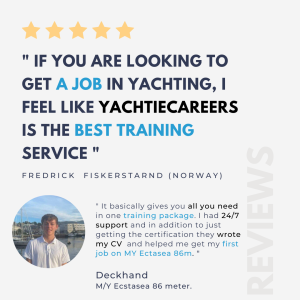
Fredrik Fiskerstrand came from a cruise ship background with solid sea service and valid certifications already in place. He took the online route — completed the superyacht-specific modules, had his CV completely rebuilt to speak to superyacht captains, and entered the job search with the right support behind him. He didn’t need to come to Split. He needed the right repositioning and the right references. That’s what the online programme gave him.
Maize Daiye came from the same situation — good service background and STCW certifications in place. Same online route. Same outcome. Both are now working in superyachts. Read their full reviews on our reviews page — they explain the process in their own words better than we can.

For cruise ship crew with valid STCW and sea service. Complete superyacht-specific stewardess modules online, get your CV professionally written and referenced by an active Chief Stewardess, and enter the superyacht job market with real support behind you.
For cruise ship deck crew with existing sea service and STCW. Complete superyacht-specific deckhand modules remotely, rebuild your CV for the superyacht market, and start your job search with references from an active Chief Officer and Bosun.
Route 2: Full 10-Day Training Week in Split (Premium Stewardess or Premium Deckhand)

A lot of cruise ship crew who decide to make the switch want the complete package — not just the certificates but the full superyacht practical training, time on an actual yacht, and the job search preparation that comes from spending 10 days in a Med marina surrounded by the industry they’re entering. This is our Premium Stewardess or Premium Deckhand programme. And this is the route Rachel and Maura took.
Both came to Split from cruise ships. Both had years of service experience behind them — real experience, the kind that builds composure, guest awareness, and the ability to perform under pressure. What they didn’t have was MCA-accepted STCW Basic Safety. Not the cruise line version — the version superyacht flag states and agencies actually require. They also didn’t have ENG1, PDSD, Crowd and Crisis Management, or the superyacht service standard that a chief stew on a 60m charter yacht expects from day one.
Day one in Split: STCW Basic Safety begins. Six days of practical safety training — firefighting, sea survival, first aid, personal safety — followed by the written exam. Alongside that runs the ENG1 medical, the PDSD, Crowd and Crisis Management. In between: the stewardess-specific modules. Silver service at an actual superyacht saloon table in the marina, not a classroom simulation. Laundry to the standard a chief stew actually checks. Cabin setup. Formal table settings. Wine service. How you set the aft deck before guests come up for sundowners and what it means when a chief stew says it’s not ready yet.
The job search doesn’t wait until the end of the week. Dock walking seminars run during the programme — active Bosuns and Chief Stewardesses walking the marina with students, knocking on boats, learning how to present yourself to a captain who’s hiring right now, in this marina, this week. You’re meeting real boats while you’re still completing your certificates.
Maura had her first job offer before the training week was over. Not at the end. During it. On a large superyacht. She started on a 70m.
Rachel came out of the same programme with a rotational contract — 4 months on, 2 months off — on an 80m superyacht. That’s not a starter position you work your way up to. That’s a serious first contract on a serious boat, straight out of training week.
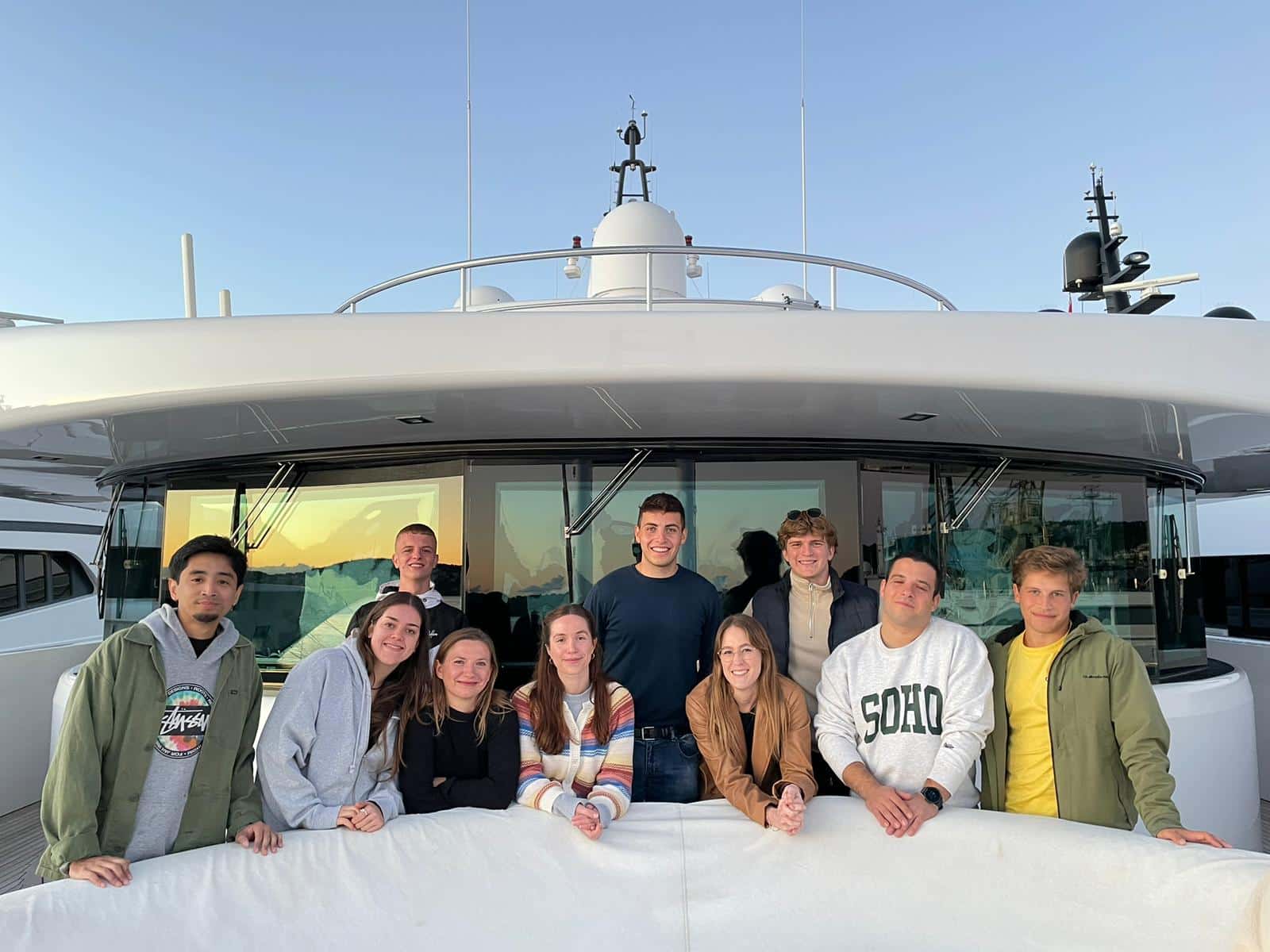
What neither of them expected was what else they got from those 10 days: each other. They arrived as strangers. One from one cruise line, one from another, both making the same jump at the same time. Ten days of training together, dock walking together, eating together in the crew accommodation in Split — you don’t do that without forming real connections. They left as friends. They’ve tracked each other through their careers since. Both staying connected through the Yachtiecareers WhatsApp group, crossing paths on boats, following each other’s next contracts.
Maura moved from junior stewardess to second stewardess. Rachel is on the same path. We follow every student the whole way — not just to placement but through the career. Junior stew to second stew to chief stew. Deckhand to bosun. When Maura needed a written reference for her second stew application, she had one from an active chief stewardess who had trained her and knew exactly what she was capable of. That reference carries weight in a way that a cold application never does. When Rachel had a question about a contract at short notice, the answer was there. That’s not an add-on. It’s what the programme actually includes.
If you’re a cruise ship crew member reading this and thinking about making the switch — this is exactly what that transition looks like when it’s done properly.
was €3,900
MCA-accepted STCW Basic Safety, ENG1 medical, PDSD, Crowd and Crisis Management, Food Hygiene Level 2, on-board superyacht training in Split marina, professionally written CV, photo session, written reference letter, 7 nights crew accommodation, and 1 year unlimited job support with 1-1 consultations. Full access from €740 deposit.
was €3,900
MCA-accepted STCW Basic Safety, ENG1 medical, PDSD, Crowd and Crisis Management, Food Hygiene Level 2, on-board superyacht deckhand training in Split marina, professionally written CV, photo session, written reference letter from Drazen or Josh, 7 nights crew accommodation, RYA Powerboat Level 2 discount, and 1 year unlimited job support. Full access from €740 deposit.
Training: What You Need and What to Watch Out For
Both cruise ships and superyachts start with STCW Basic Safety Training — no exceptions, no workarounds. If you’re coming from a cruise ship, you likely already have this. But check something before you assume it transfers: is your STCW MCA-accepted? Some cruise lines run their STCW programme to the minimum international standard, not the MCA-approved standard. Most superyacht flag states and crew agencies specifically require MCA acceptance. Bring your certificate details to a free call with our team and we’ll tell you straight away.
Beyond STCW, superyachts require:
- ENG1 Medical Certificate — fitness to work at sea, required on all commercial yachts
- PDSD — Personal Designated Security Duties, standard across the fleet
- Crowd and Crisis Management — required on yachts certified to carry more than 12 guests
- Food Hygiene Level 2 — interior crew and anyone handling food
- Role-specific training — superyacht stewardess service modules, or superyacht deckhand practical skills
Our 10-day all-inclusive programme in Split covers every certificate, on-board practical training, and a full job search programme. You start looking for work before you leave Croatia. Book a free call and we’ll tell you exactly which route — online or full training week — makes sense based on what you already hold.
Is a Cruise Ship Career Right for You?
Be honest with yourself. Cruise ships make more sense if:
- You want a structured employment contract with company HR, benefits, and defined procedures
- You prefer working in a large team where you can be anonymous and avoid people you don’t get on with
- Consistency matters to you — same routes, predictable schedule, process-driven environment
- You’re not interested in the income maximisation side — you just want a stable salary and the travel
- The idea of living in close quarters with 10–15 people 24/7 doesn’t appeal to you
Is a Superyacht Career Right for You?
Superyachts are the better choice if:
- You want to actually maximise what you earn — base salary plus real charter tips from your first contract
- You want a small team where what you do every day is visible and recognised by the people who matter
- You want to move up based on what you actually deliver — not on how long you’ve been waiting in line
- You’re motivated by going to places cruise ships can’t reach — the private bays, the off-grid anchorages, the exclusive ports
- You want shorter, more flexible contracts and control over your schedule between seasons
- You’re already on cruise ships and you want to use what you’ve built to step into something that pays significantly more and gives you a career you can actually accelerate
How to Get Your First Superyacht Job
It’s faster than most people expect — especially if you’re coming from cruise ships with sea time and service experience already behind you.
From scratch, the path is:
- MCA-accepted STCW Basic Safety Training — not negotiable, this is the foundation
- ENG1 medical certificate
- Role-specific superyacht training — interior service standard or deckhand practical
- A professional superyacht CV with a crew headshot — completely different from a standard job application
- Crew agency registration (Bluewater, OnCrew, YPI Crew, Quay Crew) and dock walking in a Med hub
For cruise ship crew: your STCW and sea service means you skip the longest part of the queue. The gap is the superyacht-specific layer — a CV that talks to superyacht captains, any missing certs, and references from the right people.
Our dock walking guide covers the full job search strategy. Read student reviews to see the full range of transitions our crew have made. Or book a free call and we’ll tell you the fastest route based on exactly where you are right now.
View our stewardess training packages, deckhand training packages, the online stewardess route, or the online deckhand route. If you want your cruise ship experience repositioned into a superyacht CV, our professional CV writing service is designed exactly for this.