To work on Yachts, one of the most appealing factors and why many starting a yacht career is the Stewardess salary you receive. The yacht Stewardess salary is depending on a lot of factors. It is a variation of monthly salary, (that is not taxed) , bonuses, tips as well as leave packages for stewardess positions. It is important to have an open mind when finding your first Junior Stewardess job in order to build experience, boost your CV and get a better salary later in your career.

How much do you make working as a Yacht Stewardess?
- Direct Yacht Stewardess Salary paid every month. Which is starting from 2500€/month depending on Yacht size, position and experience
- Paid and accrued annual leave for your yacht stewardess salary which is ranging from 40-180 days paid leave per year
- Yacht Stewardesses earn Tips which are ranging from 500€-2500€ depending on charter yacht and size and guests
- Bonuses for yacht stewardesses paid by Owners or for longevity, this is usually something like 1 month’s extra salary paid annually for longevity or completing the season.
What is a starting salary for a Yacht Stewardess in 2026?
Students that complete the yacht crew training through YachtieCareers and get a yacht job as a Stewardess, usually end up with a salary around 2500€/month.
The average salary for working as a Yacht Stewardess is 2500€-3200€ when getting the first job. But it can be more. Here is an example of a junior stewardess that after training ended up with a Yacht Stewardess salary of 3200€/month on a temporary 3-month Contract
Example Junior Yacht Stewardess Salary
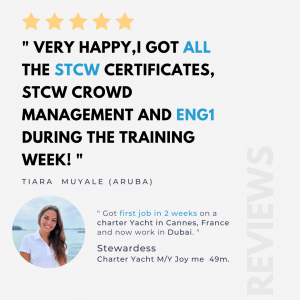
One of our ex-student managed to find a yacht job in Portugal after the Yachtiecareers Training week. And her first contract had the following terms.
- 40m Private/Charter Yacht.
- 3200€/month.
- Temp Contract (3-months)
Factors that determine the Yacht Stewardess salaries on Yachts.
The final yacht crew salary will be depending on many factors, such as if you are working in Europe or US and also the type of yacht, your experience and your position. Here are the key factors determining what your first yacht crew salary will be working on board:
- Yacht Size
Usually, the larger the Yacht the higher stewardess salary you will earn. But this is not always true, it is a good generalisation. But Yachts ranging 80-120m are usually the best paying once. There are of course exceptions where a 70m is paying a lot more than a 125m for a Yacht Stewardesses.
- Size of Interior Department
Same as above. Especially a determining factor on charter Yachts, since the tips are divided amongst the crew, a larger number of crew will result in a smaller share of the tips. But keep in mind that a the larger the crew the larger the yacht and the more expensive it is to charter, resulting in higher tips.
- Private or Charter
On a private yacht the salary is usually higher. For a starting position such as a Stewardess it is around 2500€/month. On a charter it is similar but sometimes lower than that. But on the Charter Yacht you will earn more yacht crew tips per week which will add to the salary.
- Area of Sailing (Med/Caribbean/USA)
If you are receiving a yacht stewardess salary paid in US and work in Florida and Caribbean in the past the salary range has been a bit higher. But now with a strong EUR working in the Med is starting to become the most lucrative option for getting the best Yacht crew salary.
- Stewardess Experience on board
The more experience, skills and background education you have the higher your salary on boar will be. For a Stewardess with 5 year’s experience you can earn up to 9000€/month in a Chief Stewardess role:
- Silver Service
- Wine
- Massage
- Beautician
- Yoga
- Hairdresser
- Hotel and housekeeping experience
- Service
For a Junior Stewardess without experience the starting salary can be only around the 2000€ mark. But as soon as you have a little bit extra background experience or skills it goes closer to 3000€/month in starting salary.
- Position on board
For Junior positions such as Stewardess, the starting salary range is 2000€-3800€/month.
For Medium rank positions such as 2nd Stewardess/ 3rd Stewardess/ Special skill Stewardess the salary range is: 3200€-5500€ per month.
For high ranks such as positions as Chief Stewardess and Purser, the salary is from 6000€-12000€ / month.
For executive positions such as Interior Manager the salary starts from 4000€ on a very small 20m Yacht and can range all the way up to 25000€ + on mega large yachts. In a senior yacht Stewardess position you also have 6 months paid leave per year in most large yachts and rotation.
Yacht Stewardess Salaries 2026 – A Summary
Chief Stewardess – 6000€-12000€ per month is the salary for a Chief Stewardess on board Yachts with usually a rotational contract.
2nd Stewardess – A 2nd Stewardess Yacht salary on board Superyachts in 2024 starts from 3300€-4800€/ month. And it can be more with extra skills and experience.
Stewardess – A Stewardess salary on board Superyachts starts from 2300€-3800€/ month. And it can be more with extra skills and experience.
Junior Stewardess – A Junior Deckhand salary on board Superyachts in 2024 starts from 2000€-3100€/ month. And it can be more with extra skills and experience.
Purser – Starting from 6000€ per month and goes up depending on Yacht size.
Interior Manager – Varies a lot, but with experience on a mega large yacht, the salary is often undisclosed, but sources have salaries above 20 000€/month for an Yacht interior manager role.
What You’ll Actually Earn When You Start
Your first season as a junior stewardess, you’re looking at €2,000–€2,500 per month as your base salary. On a bigger
yacht — 50m and above — that can stretch to €2,800. But most first jobs are on 30–50m yachts, so let’s be real about
that range.
I know that might sound lower than what you’ve seen on some websites. Some of them quote €3,000+ for entry level and
it just isn’t accurate for a true first season with no sea time. I’d rather give you the honest number so you’re not
disappointed, and so you can see that the real story is actually better than the headline figure suggests.
Because here’s what those numbers don’t include: tips. And they don’t account for the fact that you spend almost
nothing while you’re working.
The Part Nobody Explains Properly — Your Living Costs Are Zero
I mean that literally. When you’re on a yacht:
- You live on board — no rent
- The chef cooks crew meals — no food bills
- The yacht covers your flights home at the end of the season
- Uniform, laundry, Wi-Fi — all covered
Think about what you spend at home every month. Rent, food, transport, utilities — for most people that’s
€1,500–€2,500 before they’ve done anything enjoyable. On a yacht that’s all gone.
A junior stewardess earning €2,200/month on a yacht is in a better financial position than someone earning
€3,500/month in London or Sydney paying rent and living expenses. That’s not spin — that’s just the maths.
Tips — The Part That Can Really Change Things
If you end up on a charter yacht, tips are paid by guests at the end of each charter week. The standard is around
10–15% of the charter fee, split between the crew.
What does that actually look like? On a mid-size charter yacht (around 45–55m), you might earn €1,500–€3,000 per
charter week in tips. The Med season runs May to October and the busiest charter weeks are July and August — some
crew do four or five back-to-back charters in that peak window.
Over a full season on a busy charter yacht, a junior stew can add €8,000–€15,000 in tips on top of their base salary.
Not guaranteed — it depends on the yacht, the guests, and the season. But it’s real and it happens regularly.
Private yachts don’t do charter, so no tips. The trade-off is usually a calmer pace of life and sometimes more stable
scheduling. Both have their place depending on what you’re looking for.
What a Realistic First Season Looks Like Financially for a Junior Stewardess
Let me give you a real picture, not a best-case scenario.
A junior stewardess doing a full Med season — roughly May to October, six months:
- Base salary: €12,000–€15,000
- Tips on an average charter yacht: €5,000–€10,000
- What you spend: almost nothing
Most people go home after their first season with more savings than they’d managed in the previous two or three years
working at home. That was certainly true for me.
How Quickly Does the Stewardess salary Grow?
Faster than almost any industry I know. Yacht crew salaries move on references and sea time, not years served in an
office.
Here’s what the progression honestly looks like:
- First season: €2,000–€2,500/month — you’re learning, building sea time
- Second season: €2,500–€3,200/month — one solid reference and you’re here
- Third season: €3,000–€4,000/month — moving toward senior stew roles
- Year 4–5: Chief Stewardess on a 50m+ yacht — €4,000–€7,000/month
The jump from junior to senior happens much faster than most people expect. What matters is the quality of your
references — not how many years you’ve been doing it. Work hard, be easy to work with, ask for a written reference at
the end of every contract. That’s the formula.
Does Yacht Size Affect Your Pay?
Yes, significantly. As a rough guide:
- 30–50m: €2,000–€2,800/month — where most first jobs are
- 50–70m: €2,500–€3,500/month — needs some experience to access
- 70m+: €3,000–€5,000/month for junior crew — competitive, needs a track record
Don’t get fixated on getting a big yacht first up. The best first job is the one that gets you sea time and a
reference from a captain or chief stew who’ll actually pick up the phone for you. A great reference from a 35m yacht
opens more doors than a mediocre one from a 60m.
What About Tax on Yachts?
For most crew working on foreign-flagged yachts in international waters — which is most superyachts — your income
isn’t subject to income tax in your home country. UK and Australian crew in the Mediterranean and Caribbean generally
operate tax-free for the duration of their contracts.
Always check with an accountant for your specific situation, but in practice this is how the industry works and it’s
one of the reasons yacht crew can save so aggressively in a short period of time.
What You Need Before You Can Start Earning
Every yacht — without exception — requires STCW Basic Safety Training before you can legally work on board. No agency
will register you without it, and no captain will take you on without it. It’s 5 days, valid for 5 years globally.
Beyond STCW, our stewardess training covers the practical skills that actually get you hired — silver service, wine knowledge, table setting, cocktails, interior management. Students who do both consistently land their first position faster than those who only have STCW.
If you’re serious about starting this season, the time to book is now. The Med season is already underway and
captains are hiring.
See the full stewardess training package
→
Written by Ivana — Chief Stewardess, 50m superyachts. Have questions before you commit? Message us directly — our team responds within 24 hours and I’m happy to answer anything about what the job is actually like day to day.