There are a lot of deckhand training courses. Most of them will give you a certificate. Very few of them will get you a job. The difference — and I say this as a Chief Officer with 10 years on 100m superyachts who now trains deckhands — is whether the course was designed around what captains and bosuns actually need from first-season crew, or just designed to pass people through a mandatory safety requirement. This guide tells you what to look for, what the full certificate stack costs, and which programmes are actually worth your time and money. For the full deckhand career path from zero to first contract, read our deckhand career guide. For STCW specifics, read our STCW guide. For salary at every level, see our yacht crew salary guide.
What the Best Deckhand Training Programmes Have in Common
Before you book, three questions worth asking any provider:
- Is your STCW MCA-accepted? If they can’t give you a straight yes and their MCA approval reference, the certificate won’t be accepted by crew agencies or captains. Don’t waste money on a certificate that gets rejected at the application stage.
- Does the training include practical on-board time on a real vessel? Deckhand work is physical — line handling, tender operations, anchor work, deck maintenance. A classroom course cannot teach you how to behave on a moving vessel. If the practical training isn’t on a real yacht, it’s not adequate preparation.
- What job search support is included after the course? Most programmes hand you a certificate and wish you luck. The ones worth paying for include CV writing, dock walking preparation, and crew agency access as part of the package.
If a programme ticks all three, it’s worth serious consideration. If it doesn’t, keep looking — because the certificate is only the beginning. Getting your first job is the hard part, and you need support through that phase.

The Full Certificate Stack — What a Superyacht Deckhand Actually Needs
Five certificates are required before any captain will consider you for a deckhand position on a commercial superyacht. None of them are optional:
- STCW Basic Safety Training — the mandatory foundation for anyone working commercially at sea. Four practical elements: Personal Survival Techniques, Fire Prevention and Firefighting, Elementary First Aid, Personal Safety and Social Responsibilities. Must be MCA-accepted. Requires 5–6 days of in-person practical training — cannot be done fully online.
- ENG1 Medical Certificate — proof you’re medically fit to work at sea. Issued by an approved maritime doctor. Required before your first paid contract.
- PDSD (Personal Designated Security Duties) — required on most commercial vessels. MCA-accepted security awareness certificate.
- Crowd and Crisis Management — required for vessels carrying more than 12 guests. Applies to virtually all charter superyachts.
- Food Hygiene Level 2 — required for crew who handle food. Most deckhands are expected to have this, even if the galley isn’t their primary role.
Doing these separately across different UK providers takes 4–12 weeks and costs £1,000–£2,000+ before accommodation and travel. An all-inclusive programme in the Med completes all five in 10 days in one location — and puts you in a yachting hub immediately after qualifying.
Beyond the mandatory certificates, PowerBoat Level 2 is expected for tender operations on most yachts and worth adding either during training or in your first season.
What Good Deckhand Training Actually Covers
Deck Skills That Matter On Board
A bosun assessing a new deckhand in the first week is looking for specific things: do they handle lines properly, do they know how to work safely on deck around guests, can they operate a tender without embarrassing the boat, do they understand anchor procedures well enough to be useful rather than a liability. These aren’t taught in a classroom — they’re learned through practical repetition on a vessel.
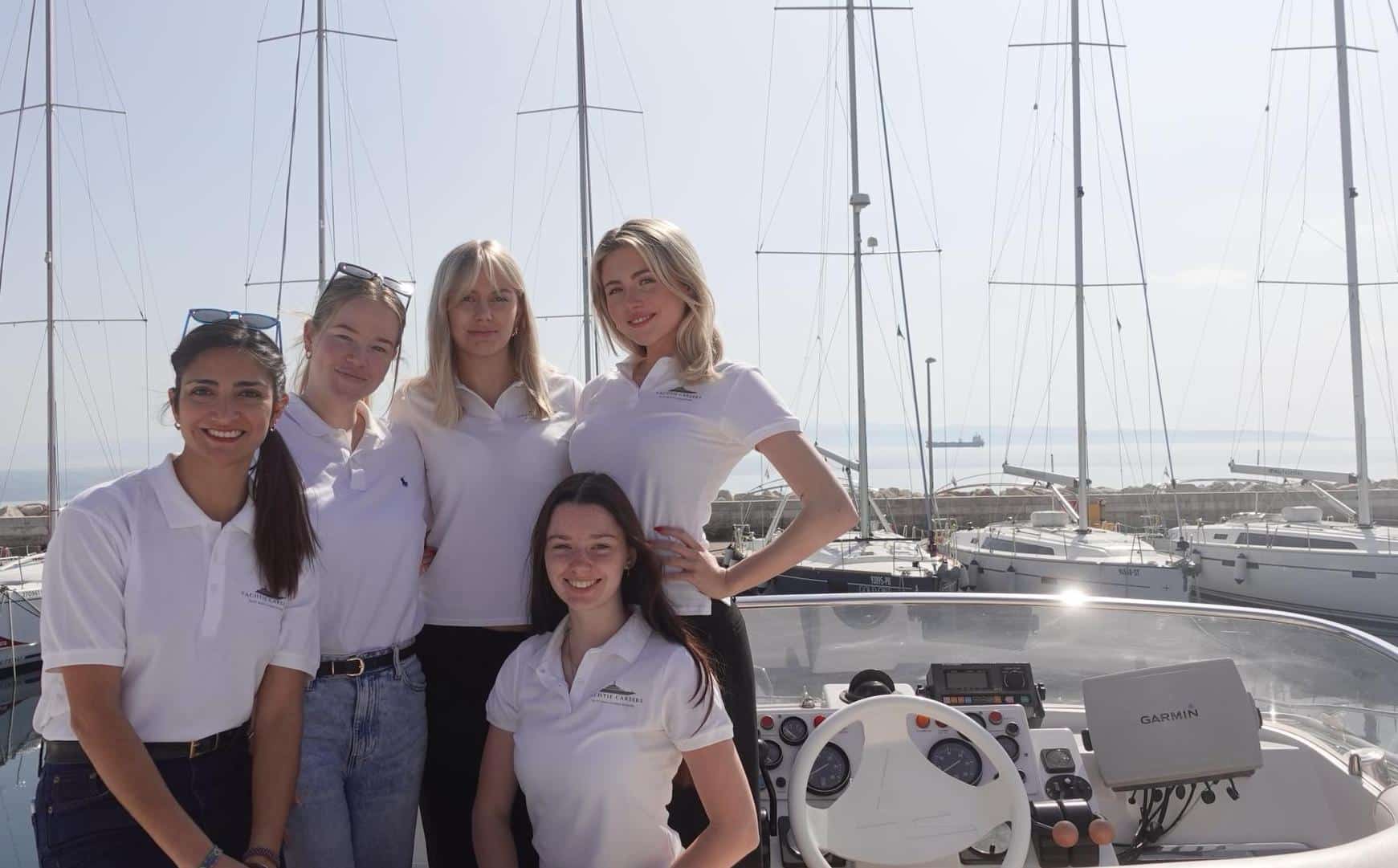
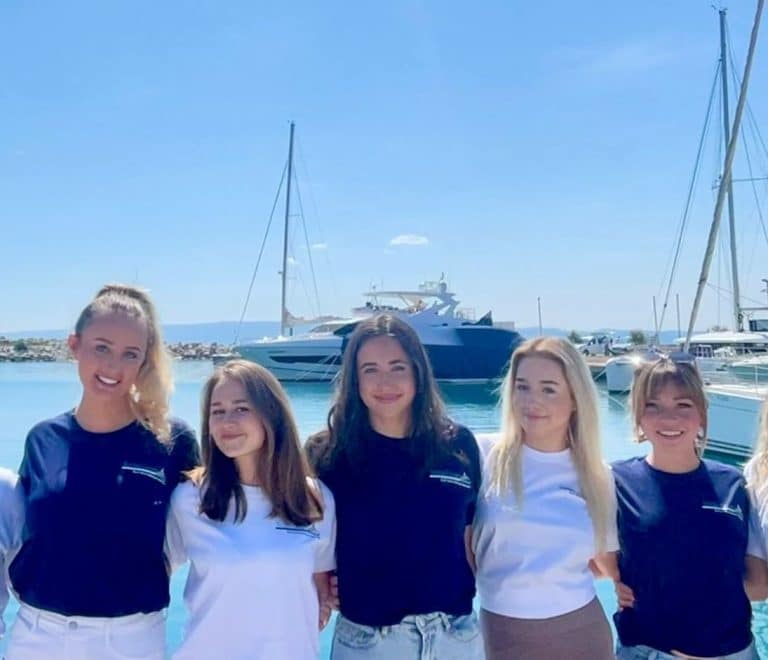
At Yachtiecareers, deckhand on-board training covers: anchoring, mooring and line handling, teak maintenance and deck cleaning protocols, tender operations, working aloft, jet ski and watersports handling, and guest safety on deck. These are delivered on a real yacht in Split marina, not in a training room on shore. The online platform modules cover the same topics with the theory and context behind each skill — so when students arrive for the practical days, they’re already familiar with what they’re about to do.
Instructors Who Know What Bosuns Are Looking For
Jack and Josh, our Bosun instructors, are both currently working on superyachts. When they teach deck skills, they’re teaching the standard they’d expect from a new crew member on their own boat. That’s a different level of preparation than a training instructor who has never actually worked a Med charter season.
Drazen, our Chief Officer with 10 years on 100m superyachts, teaches the on-board context — what captains look for, how the deck team operates, what the hierarchy means in practice, and what makes a first-season deckhand someone a bosun wants to keep around rather than replace at the end of the season.
The Job Search Is Part of the Training
Three days of the 10-day programme at Yachtiecareers are dedicated to the job search: dock walking seminars in Split marina with active crew, CV writing and review, crew agency registration, and interview preparation. This isn’t a bolt-on — it’s built into the programme because getting the job is the actual goal, not just getting the certificate.
Most maritime training courses finish on the last practical day and leave students to figure out the rest. The crew who struggle to find their first job after training aren’t usually lacking certificates — they’re lacking the right CV, the right approach to dock walking, and contacts in the industry. We address all three before students leave Split.
Training Providers Worth Knowing
Yachtiecareers — Split, Croatia
The only all-inclusive programme in the Mediterranean covering every required certificate, practical on-board training, and full job search support in a single 10-day programme. Full Package €2,395, Premium Package €2,940. Instructors are active Chief Officers, Bosuns, and Chief Stewardesses. MCA-accepted STCW. Students complete training and begin their job search from Split — a Med yachting marina — without needing to travel separately for their job hunt. Full details on our deckhand training page.
Resolve Academy — Florida
One of the US most established maritime training providers. MCA and RYA approved. Solid STCW training. No job search support and US-based — useful if you need to stay local, but you’ll need to travel to the Med separately to find work and you’ll be doing it without preparation support.
UKSA — Isle of Wight, UK
Long-established sailing and maritime academy. Good reputation, particularly for crew going into sailing yachts. RYA training centre. As with other UK providers, no job search support included and no Med location advantage.
Why Location Changes Everything
Most deckhand job searching on superyachts still happens through dock walking and personal contact — not through job boards. Captains and bosuns hire people they’ve met, or who come recommended. If you finish your training in the UK and then fly to Antibes or Split to find work, you’re arriving weeks behind crew who trained in the Med and started dock walking the day their course ended.
Split is a working Med marina. During the April–June window, it’s full of yachts preparing for the summer season and captains actively looking for crew. Finishing your training there and beginning your dock walking immediately — with a properly written CV and a practised approach — is the fastest route to your first contract. Read our full dock walking guide for the complete strategy.
What Our Graduates Actually Achieve
Fredrik Fiskerstrand from Norway made the switch from cruise ships to superyachts through Yachtiecareers. He had two deckhand role offers within his first week after training and now works on an 86m MY. Jordan Prendergast got a job before the training week was even over. Kim Homburg from the Netherlands landed her first job during the programme itself.
These aren’t outliers — they’re the result of arriving in the right place with a complete certificate pack, a strong CV, and a dock walking approach taught by people who work in the industry. The crew who struggle after training are usually the ones who finished their certificates at home and then tried to job search remotely.

“Could not have wished for anything better. During this program we were guided from start to finish, which led me to landing my first job before the program even finished.”
— Kim Homburg, Netherlands ★★★★★
What Deckhands Earn — The Numbers
Junior deckhand in the first season: $2,500–$3,200/month. After 1–2 years: $3,000–$4,000/month. Bosun: $4,500–$6,500+/month. On charter yachts, tips add $500–$2,000 per charter week on top of base salary. A full Med summer season of 15–20 charters can add $10,000–$40,000 in tips split across the deck team.
The career path for a deckhand: deckhand → senior deckhand → bosun (2–4 years) → second officer with the right RYA or STCW officer qualifications. Officers on 60m+ yachts earn $5,000–$8,000+/month. The training cost is recovered within the first two months of a first contract.
What the Training Costs

At Yachtiecareers: Full Package €2,395, Premium Package €2,940. Both include every required certificate — STCW, ENG1, PDSD, Crowd Management, Food Hygiene — plus on-board practical training on a real yacht, deck skills modules through YCA, CV preparation, dock walking seminars, crew agency registration, and 24/7 WhatsApp access to active instructors.
The Premium Package adds: 7 nights crew accommodation in Split, 1-1 CV writing with an active crew member, unlimited CV updates for 1 year, a written reference letter from a Chief Officer, 1 year unlimited career support with 1-1 consultations, and dual access to stewardess training content. Secure your place with a €740 deposit. Premium is available in two payments of €1,470.
Start Your Deckhand Career This Season
10 days in Split, Croatia. Every certificate. Practical on-board training with active Bosuns and Chief Officers. CV writing, dock walking prep, and job search support built into the programme.
Premium Package from €2,940 — 7 nights accommodation, 1-1 CV writing, reference letter from a Chief Officer, 1 year unlimited career support.
Not sure which package is right for you? Book a free call with our team, or read what graduates say on our reviews page.